Breaking point became a turning point for this domestic violence survivor
Shobha Shukla, CNS (Citizen News Service)
 The
whereabouts of Sheela’s husband are not known since the last 10 years.
When he left home in 2007, Sheela was three months pregnant with her
fifth child. The last she heard from him was one month after the birth
of this child - a daughter. When he heard the news, he sent her INR 1000
through his brother, but did not come home to see her. Since then,
there has been complete silence on his part.
The
whereabouts of Sheela’s husband are not known since the last 10 years.
When he left home in 2007, Sheela was three months pregnant with her
fifth child. The last she heard from him was one month after the birth
of this child - a daughter. When he heard the news, he sent her INR 1000
through his brother, but did not come home to see her. Since then,
there has been complete silence on his part.
 The
whereabouts of Sheela’s husband are not known since the last 10 years.
When he left home in 2007, Sheela was three months pregnant with her
fifth child. The last she heard from him was one month after the birth
of this child - a daughter. When he heard the news, he sent her INR 1000
through his brother, but did not come home to see her. Since then,
there has been complete silence on his part.
The
whereabouts of Sheela’s husband are not known since the last 10 years.
When he left home in 2007, Sheela was three months pregnant with her
fifth child. The last she heard from him was one month after the birth
of this child - a daughter. When he heard the news, he sent her INR 1000
through his brother, but did not come home to see her. Since then,
there has been complete silence on his part.

Work towards the Delhi call for action to end TB
[First publishrd in the India Saga]

Using ICT to end TB
Francis Okoye, CNS Correspondent, Nigeria
As the world advances, new idea and technologies are taking root in all fields, especially in the medical field. This brings us to the idea of using information and communication technologies to help control TB. The new technology being applied is called mobile health or mHealth, and in a webinar titled ‘Can mHealth help accelerate progress towards ending TB?’ hosted by CNS, experts explained how the new technology is being applied in India in the rural as well as urban areas. Mobile health technology is being used in different ways by TB programs in some high burden countries.
 |
| Photo credit: Ashok Ramsarup |
26/9 Webinar: Scientific highlights of the 48th Union World Conference on Lung Health
 [Webinar recording] [Listen/download audio podcast] The 48th Union World Conference on Lung Health will be held during 11-14 October 2017 in Guadalajara, Mexico on the theme of "Accelerating towards elimination".
Leveraging mHealth for tackling TB in India
Urvashi Prasad, CNS Correspondent, India
 India accounts for a large part of the world’s TB burden. As highlighted by Dr Suneetha Narreddy, Infectious Diseases Expert, Apollo Hospitals, Hyderabad, during a webinar organised by CNS, there are approximately 2.6 million cases of TB annually in India. Unfortunately, nearly 1 million cases are missed every year on account of poor notification, especially from the private sector where 50% of patients are treated, as well as the absence of standardised diagnostic and treatment practices.
 India accounts for a large part of the world’s TB burden. As highlighted by Dr Suneetha Narreddy, Infectious Diseases Expert, Apollo Hospitals, Hyderabad, during a webinar organised by CNS, there are approximately 2.6 million cases of TB annually in India. Unfortunately, nearly 1 million cases are missed every year on account of poor notification, especially from the private sector where 50% of patients are treated, as well as the absence of standardised diagnostic and treatment practices.
Technology can help improve TB management: Experts
Aarti Dhar, CNS Correspondent, India
 [First published in the India Saga]
Simple technology, such as basic mobile phones, can help in improving TB management, experts suggest. At least two pilots, conducted in India, have shown increased adherence to treatment regimen and improved the notification of the disease, particularly in the private sector.
[First published in the India Saga] Simple technology, such as basic mobile phones, can help in improving TB management, experts suggest. At least two pilots, conducted in India, have shown increased adherence to treatment regimen and improved the notification of the disease, particularly in the private sector.
Women united will never be defeated…
Shobha Shukla, CNS (Citizen News Service)
 That was the reverberating chant that greeted the dawn of the third and final day on 'Action' theme at the 3rd Asia Pacific Feminist Forum (APFF 2017), which was organized by the Asia Pacific Forum on Women, Law and Development (APWLD) in Chiang Mai, Thailand.

Anger gives way to hope, for "if winter comes, can spring be far behind?"
Shobha Shukla, CNS (Citizen News Service)
 Anger of day one gave birth to HOPE on the second day of the 3rd Asia Pacific Feminist Forum (APFF 2017), which is being organised in the 'Land of a Thousand Smiles' - Thailand - under the aegis of Asia Pacific Forum on Women, Law and Development (APWLD). Feminists from the Asia Pacific region, kindled a new optimism to collectively strike at the rise of authoritarian, patriarchal, late capitalism, by organising movements, for a more equitable and just world, through hope and love.

Anger begets hope and drives constructive action for a better tomorrow
Shobha Shukla, CNS (Citizen News Service)
 More than 300 feminist activists, women human rights defenders and global allies are gathered in Chiang Mai, Thailand under the banner of '(re)Sisters, (per)Sisters and Sisters', for the 3rd Asia Pacific Feminist Forum (APFF 2017). This 3 days Forum (7-9 September 2017) has been organised around the framework of 'Anger, Hope and Action'.

Collective action and structural changes are vital for gender justice
Shobha Shukla, CNS (Citizen News Service)
[Watch video, listen podcast] Judy Taguiwalo is a politician as well as a women's rights activist of Philippines. She is the former Minister of Department of Social Welfare and Development of Philippines. Since her student days she has been in the forefront of advancing women’s rights, in relation to societal changes, and has been a member of Asia Pacific Forum on Women, Law and Development (APWLD) since 1987.
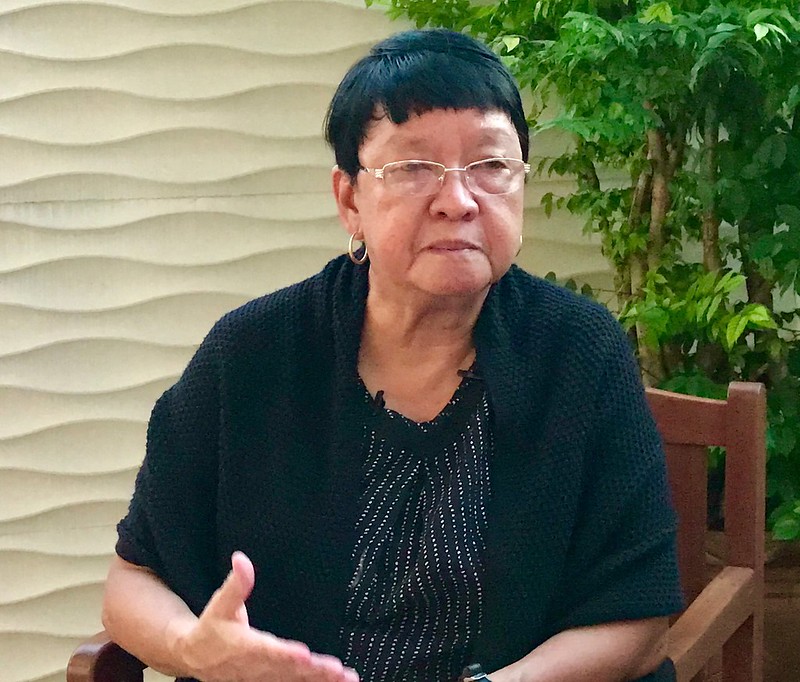 |
| Judy Taguiwalo, politician and women's rights leader |
[Spotlight] Feminism is about solidarity, not about matriarchy
Shobha Shukla, CNS (Citizen News Service)
 Globally, and in the Asia Pacific region, an authoritarian patriarchal rule is ascendant and feminist space is under increased attack. In order to exist, we sisters (or rather like minded feminists, who do not necessarily have to be females) will have to resist and persist. Resist this patriarchal ascendency and the consequent threats to civil society. And persist to challenge the exploitations and inequalities that are driving us towards unsustainable development.
 Globally, and in the Asia Pacific region, an authoritarian patriarchal rule is ascendant and feminist space is under increased attack. In order to exist, we sisters (or rather like minded feminists, who do not necessarily have to be females) will have to resist and persist. Resist this patriarchal ascendency and the consequent threats to civil society. And persist to challenge the exploitations and inequalities that are driving us towards unsustainable development.
Patriarchy abets the malaise of bride kidnapping
Shobha Shukla, CNS (Citizen News Service)
Bride kidnapping (marriage by abduction or capture) is still rampant in many Caucasian countries, including Kyrgyzstan. In fact, the 2015 Convention on the Elimination of All Forms of Discrimination against Women (CEDAW) committee report expressed its alarm at the high prevalence of marriages in Kyrgyzstan that result from bride kidnapping, which appears to be socially legitimized!
 |
| Aizhamal Bakashova, SHAZET, Kyrgyzstan (CNS image archives, 2015) |
Women human rights defenders spearheading struggle for a better tomorrow
Shobha Shukla, CNS (Citizen News Service)
The talk about 'sustainable development' and 'no one left behind' looks difficult to believe when people's lives, livelihoods, human rights and dignity are violated in pursuit of the so-called development . Bee Pranom Somwong, who works with Protection International, and is also among the key participants at the 3rd Asia Pacific Feminist Forum (APFF 2017), which opens later this week in Chiang Mai, Thailand (7-9 September 2017), was recently in conversation with CNS (Citizen News Service) on the current development model.
 |
| Photo courtesy: Bee Pranom Somwong, Protection International |
Is global development agenda rooted in local realities?
Shobha Shukla, CNS (Citizen News Service)
Global processes for development should be rooted in and informed by the grassroots movements. But is there a gap or disconnection? Can we do better to ensure that development discourses at all levels are plugged in affected communities on the frontlines?
 |
| Photo courtesy: Reasey Seng, Cambodia |
Subscribe to:
Posts (Atom)