Favelas in Rio de Janeiro are dense, informal urban communities where over a million people live across more than 1,000 such settlements. Quite a few of them are considered dangerous, some heavily controlled by armed drug-trafficking factions and sites of violent police operations. I could visit one such favela: Morro dos Prazeres in Santa Teresa neighbourhood.
I was fortunate to be part of an educational tour organised by the conference with two local organisations that serve people in this favela: CEDAPS (Centro de Promoção da Saúde or Centre for Health Promotion) and its partner organisation, Instituto Evolux.
Moro dos Prazeres favela became quite popular globally after it was a location of a 2008 movie Elite Squad (Tropa de Elite) as well as for hosting MTV's celebrity football tournament Rockgol in 2011.
Perched 275 metres above sea level, Morro dos Prazeres (which translates to 'Hill of Pleasures') offers breathtaking panoramic views of Guanabara Bay (Bosom of the sea) and the sprawling city below. But behind this picturesque landscape lies a very different reality. Residents continue to face daily barriers to healthcare, education, sanitation and other basic services that directly influence their health outcomes.
The visit showcased how CEDAPS strengthens community participation and advances health equity in vulnerable urban territories through participatory methodologies and community-led approaches addressing HIV, TB, and broader social wellbeing.
Communities co-creating their own solutions

What quickly became evident during our visit was that these communities are not waiting for solutions to arrive from outside. They are creating their own and making HIV prevention meaningful.
During our visit we met community leaders, artists, journalists, youth advocates and health workers who are finding innovative ways to communicate about HIV prevention in a language that is simple, culturally relevant and rooted in everyday life.
 |
| Aparecida Maria speaking (Umbrella of prevention) |
The colourful umbrella is decorated with water-drop shaped cards, each carrying a number. A box kept under the umbrella has numbered paper chits with some message written on each of them. Participants are invited to pick a numbered drop, after which the corresponding message is drawn from the box and read aloud to the group.
Transforming health lecture into community conversation
The messages cover practical health information in an engaging and interactive manner.
One such message explains proper cough etiquette to reduce the spread of TB: ‘When coughing or sneezing, cover your mouth with the crook of your elbow.' Do not use your hands. Because then the bacteria will be lodged in it. And when touching people or objects you can spread the disease… Or else use a disposable tissue and avoid close contact with other people.'
Another reminds participants that ‘irregular treatment can complicate disease and reduce the chances of recovery.'
One such message explains proper cough etiquette to reduce the spread of TB: ‘When coughing or sneezing, cover your mouth with the crook of your elbow.' Do not use your hands. Because then the bacteria will be lodged in it. And when touching people or objects you can spread the disease… Or else use a disposable tissue and avoid close contact with other people.'
Another reminds participants that ‘irregular treatment can complicate disease and reduce the chances of recovery.'
The exercise transforms health education into a community conversation rather than a lecture, making complex information easier to understand, particularly for young people.
Artist Carla Felizardo has chosen a different medium.
Through paintings and creative expression, she raises awareness not only about HIV but also about broader issues affecting health and wellbeing. Her artwork serves as a bridge between science and community, encouraging dialogue among adults, adolescents and children alike.
For Carla, art becomes an accessible language capable of reaching people who may never attend a formal health education session.
Karen, a community journalist, uses audiovisual storytelling to communicate health information in a direct and accessible way.
Working collaboratively across different favelas in Rio de Janeiro, he shares locally produced content that amplifies community voices while increasing the reach of health messages.
But for Karen, discussing HIV cannot happen in isolation.
"We do not talk just about the lack of healthcare," he explained. "We also talk about the lack of basic sanitation, the lack of education, and how this impacts the health of residents."
His words reflected one of the strongest messages from the visit—that health inequities are inseparable from broader social inequities.
CEDAPS also works extensively in Rocinha - Brazil's largest favela - which is home to approximately 72,000 people.
Despite being one of Rio de Janeiro's well-known tourist destinations, Rocinha continues to experience complex social challenges, including territorial disputes between armed groups that can erupt into sudden violence.
Yet even within these difficult environments, community-led health programmes continue to flourish.
One of the most inspiring conversations of the day was with the coordinator of CEDAPS' Youth Network, a collective of young people living with HIV that has worked since 2009 as Brazil's national partner of the global YouthBuild initiative.
She spoke candidly about the multiple vulnerabilities facing young people living in Brazil's favelas.
"The people who die most in the country are young Black people who live in the favelas and marginalised territories," she said.
TB remains especially common among these communities, where access to information and healthcare is often limited.
"We have been exploring strategies on how to effectively communicate with our peers living with HIV that TB is a reality that has killed many young people," she explained.
Art as a Tool for Health Education
 |
| Artist Carla Felizardo speaking |
Through paintings and creative expression, she raises awareness not only about HIV but also about broader issues affecting health and wellbeing. Her artwork serves as a bridge between science and community, encouraging dialogue among adults, adolescents and children alike.
For Carla, art becomes an accessible language capable of reaching people who may never attend a formal health education session.
Storytelling That Reflects Reality
Karen, a community journalist, uses audiovisual storytelling to communicate health information in a direct and accessible way.
Working collaboratively across different favelas in Rio de Janeiro, he shares locally produced content that amplifies community voices while increasing the reach of health messages.
But for Karen, discussing HIV cannot happen in isolation.
"We do not talk just about the lack of healthcare," he explained. "We also talk about the lack of basic sanitation, the lack of education, and how this impacts the health of residents."
His words reflected one of the strongest messages from the visit—that health inequities are inseparable from broader social inequities.
Working in Brazil's largest favela
CEDAPS also works extensively in Rocinha - Brazil's largest favela - which is home to approximately 72,000 people.
Despite being one of Rio de Janeiro's well-known tourist destinations, Rocinha continues to experience complex social challenges, including territorial disputes between armed groups that can erupt into sudden violence.
Yet even within these difficult environments, community-led health programmes continue to flourish.
Young people leading the response
One of the most inspiring conversations of the day was with the coordinator of CEDAPS' Youth Network, a collective of young people living with HIV that has worked since 2009 as Brazil's national partner of the global YouthBuild initiative.
She spoke candidly about the multiple vulnerabilities facing young people living in Brazil's favelas.
"The people who die most in the country are young Black people who live in the favelas and marginalised territories," she said.
TB remains especially common among these communities, where access to information and healthcare is often limited.
"We have been exploring strategies on how to effectively communicate with our peers living with HIV that TB is a reality that has killed many young people," she explained.
 One innovative initiative involves specially designed T-shirts displaying an illustration of the lungs to highlight the increased burden of TB among people living with HIV.
The reverse side of each shirt explains the Brazilian Unified Health System (SUS), reminding young people that universal healthcare - including HIV services - is their legal right. Anyone diagnosed with HIV is entitled to comprehensive care, treatment and follow-up.
The Youth Network also transformed Festa Junina - Brazil's traditional June festival - into an opportunity for health promotion. As part of the celebrations they organised a Care Festival for which they made colourful decorative flags carrying messages about HIV and TB prevention, like:
- Everyone living with HIV should be screened for TB
- TB is curable
- HIV treatment saves lives
- Undetectable = Untransmittable (U=U)
By embedding health information into cultural celebrations, the messages reached people in ways that felt natural rather than intimidating.
The coordinator ended with a powerful reminder that lingered with me long after our conversation had ended: "It is possible to live with HIV. But it is not possible to live with the stigma we still carry."
Comprehensive care for LGBTQIA+ communities
Members of Community Service Centre of the Rainbow Group, were also present and psychologist Rick described the organisation's work supporting LGBTQIA+ communities.
The Rainbow Group advocates for LGBTQIA+ rights by combating discrimination, promoting diversity and advancing social inclusion. It works closely with Rio Sem LGBTfobia, Rio de Janeiro's public programme to combat discrimination and violence against LGBTQIA+ people. The organisation is also famous for coordinating Rio's annual Pride Parade along Copacabana Beach and for hosting the city's largest LGBTQIA+ choir that performs at major cultural venues in Rio.
Rick explained that the Community Service Centre provides much more than HIV testing. Its multidisciplinary team of psychologists, lawyers and social workers offers free rapid testing for HIV, syphilis, viral hepatitis and other sexually transmitted infections, while also providing counselling, referrals and community-based support for both Pre-Exposure Prophylaxis (PrEP) and Post-Exposure Prophylaxis (PEP).
For many clients, however, the greatest need extends beyond medical care.
People often arrive carrying significant psychosocial distress, requiring comprehensive support that addresses mental health, discrimination, legal challenges and social isolation alongside HIV prevention and treatment.
Communities at the heart of the response
Perhaps the most important lesson from Morro dos Prazeres was that community health workers remain the true gateway to healthcare.
They serve everyone who seeks help, regardless of social or economic status, linking residents to public health services while building trust within communities.
We also learnt that Brazil's health system places strong emphasis on protecting the rights and confidentiality of people living with HIV. Health information, including viral load results, is safeguarded under data protection legislation, ensuring that only the treating physician has access to sensitive clinical information.
Confidentiality, dignity and respect are not optional extras - they are fundamental to effective HIV care.
As the global HIV response embraces the AIDS 2026 theme, "Rethink - Rebuild -Rise," the visit to Morro dos Prazeres offered a powerful reminder that lasting progress begins within communities themselves.
Whether through an umbrella decorated with messages, paintings that spark conversations, colourful festival flags, community journalism or peer-led youth networks, the people of Rio's favelas are demonstrating that the most effective health interventions are those created by communities, for communities.
Their work is not only improving access to HIV and TB services - it is redefining what community-led health equity looks like.
(Citizen News Service)
6 August 2026

 |
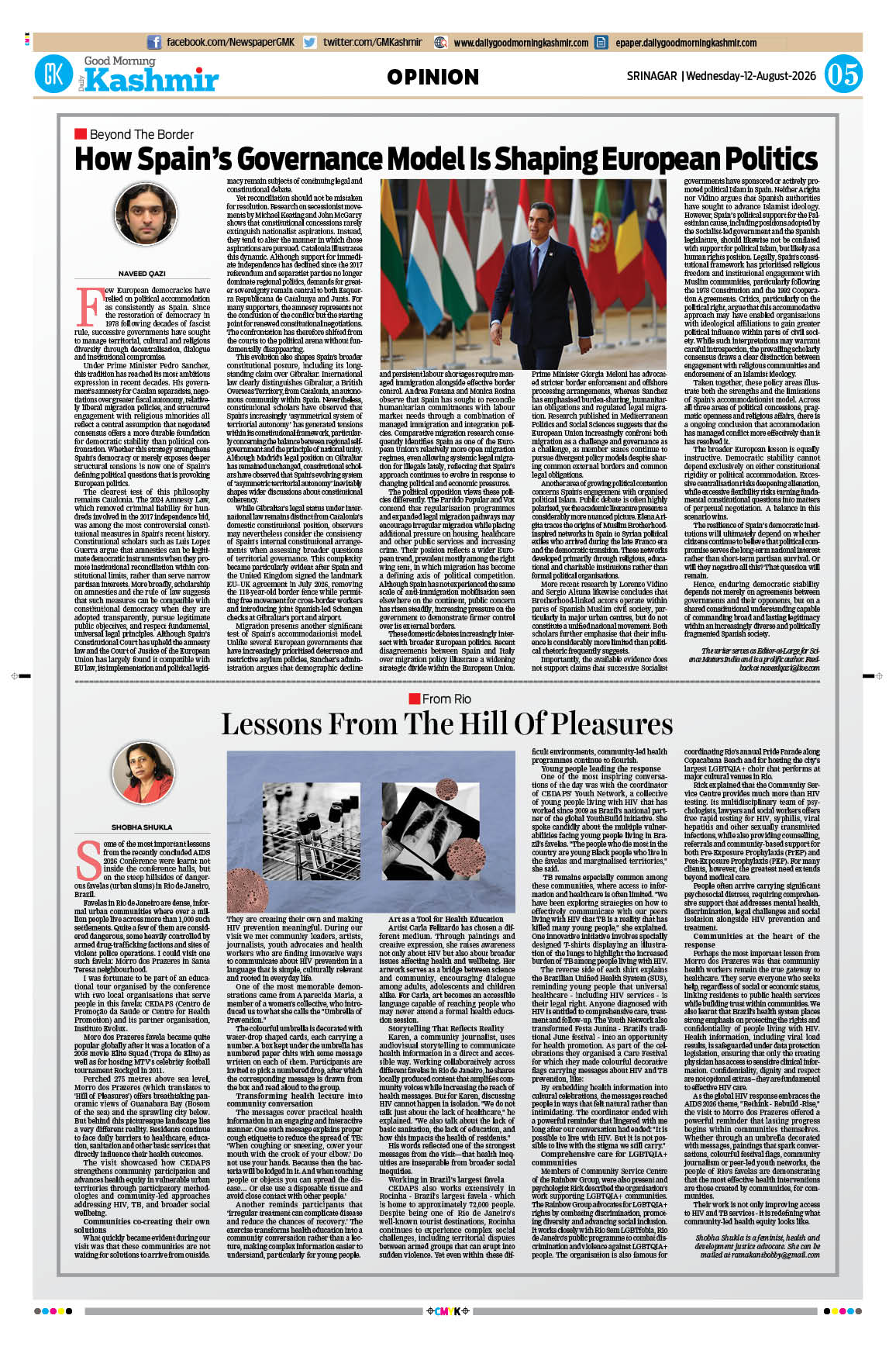
| Central Chronicle, India (op-ed page, 12 August 2026) |
 |
| Daily Good Morning Kashmir, India (op-ed page, 12 August 2026) |
 |
| The Sangai Express, India (part-1, op-ed page, 17 August 2026) |
 |
| The Sangai Express, India (part-2, op-ed page, 18 August 2026) |
 |
| The Sangai Express, India (part-3, op-ed page, 19 August 2026) |
 |
| The Sangai Express, India (part-4, op-ed page, 20 August 2026) |
 |
| The Sangai Express, India (part-5, op-ed page, 21 August 2026) |
 |
| The Sangai Express, India (part-6, op-ed page, 22 August 2026) |
 |
| The Sangai Express, India (part-7, op-ed page, 24 August 2026) |
 |
| The Sangai Express, India (part-8, op-ed page, 26 August 2026) |
 |
| Central Chronicle, India (op-ed page, 27 August 2026) |
 |
| The Sangai Express, India (part-10, op-ed page, 28 August 2026) |
 |
| The Sangai Express, India (part-11, op-ed page, 29 August 2026) |
 |
| The Sangai Express, India (part-12, op-ed page, 31 August 2026) |
 |
| The Sangai Express, India (part-13, op-ed page, 1 September 2026) |
 |
| The Sangai Express, India (part-14, op-ed page, 2 September 2026) |
 |
| The Sangai Express, India (part-15, op-ed page, 3 September 2026) |
 |
| The Sangai Express, India (part-16, op-ed page, 4 September 2026) |
 |
| The Sangai Express, India (part-9, op-ed page, 27 August 2026) |
 |
| The Sangai Express, India (part-17, op-ed page, 5 September 2026) |
 |
| The Sangai Express, India (part-18, op-ed page, 7 September 2026) |
 |
| The Sangai Express, India (part-19, op-ed page, 8 September 2026) |
published in:
- CNS
- Central Chronicle, India (op-ed page, 12 August 2026)
- Daily Good Morning Kashmir, India (op-ed page, 12 August 2026)
- Modern Ghana
- Eurasia Review, Spain
- Scoop Independent News, New Zealand
- The Forefront Magazine, Rwanda
- Visor News, Mozambique
- FYN Media, Cambodia
- Efficacy News, South Africa/ Zambia
- Pakistan Christian Post
- e-Pao News Network, Manipur, India
- Central Chronicle, India (op-ed page, 27 August 2026)
- The Sangai Express, India (part-1, op-ed page, 17 August 2026)
- The Sangai Express, India (part-2, op-ed page, 18 August 2026)
- The Sangai Express, India (part-3, op-ed page, 19 August 2026)
- The Sangai Express, India (part-4, op-ed page, 20 August 2026)
- The Sangai Express, India (part-5, op-ed page, 21 August 2026)
- The Sangai Express, India (part-6, op-ed page, 22 August 2026)
- The Sangai Express, India (part-7, op-ed page, 24 August 2026)
- The Sangai Express, India (part-8, op-ed page, 26 August 2026)
- The Sangai Express, India (part-9, op-ed page, 27 August 2026)
- The Sangai Express, India (part-10, op-ed page, 28 August 2026)
- The Sangai Express, India (part-11, op-ed page, 29 August 2026)
- The Sangai Express, India (part-12, op-ed page, 31 August 2026)
- The Sangai Express, India (part-13, op-ed page, 1 September 2026)
- The Sangai Express, India (part-14, op-ed page, 2 September 2026)
- The Sangai Express, India (part-15, op-ed page, 3 September 2026)
- The Sangai Express, India (part-16, op-ed page, 4 September 2026)
- The Sangai Express, India (part-17, op-ed page, 5 September 2026)
- The Sangai Express, India (part-18, op-ed page, 7 September 2026)
- The Sangai Express, India (part-19, op-ed page, 8 September 2026)