- Home
- Issues
- Advocacy and campaigning Days
- Tuberculosis
- COVID-19
- HIV/AIDS
- Hepatitis
- Non-communicable diseases (NCDs)
- Diabetes
- Cancer
- Asthma
- End tobacco
- Anti-microbial resistance
- Health security
- Gender justice
- Climate justice
- Development justice
- Pneumonia
- Malaria
- Sustainable energy
- Nuclear disarmament
- Corporate accountability
- Correspondents
- Publications
- Online communications
- Conference coverage
- GAMA
- सीएनएस
- About
Showing posts with label IAS 2025. Show all posts
Person-centred care is the gateway to health for all
The irony of current times is that despite the writing on the wall "health is a fundamental human right," the ground reality cannot be farther from the truth. Over 70% people die of non-communicable diseases (NCDs) - a significant number of them are preventable. An infectious disease like TB, which is preventable and curable, continues to be the deadliest infectious disease worldwide - especially in the Global South. When HIV combination prevention should be a reality, along with treatment as prevention, over 630,000 people died of AIDS-related illnesses in 2024 - and 1.3 million were newly diagnosed with HIV in 2024 (hardly any change when compared with 2023 data). If every life matters, then why is A for accountability, missing from global health?
Will we-the-quails unite to lift the net or wither away the gains made in AIDS response?
Let us refresh the old gold Buddhist tale of The Quail and the Net: “Long ago a flock of quails lived in a forest. Everyday a hunter would cast a net and trap many of them. But eventually, a wise quail told the rest that if they worked together, they could lift the net collectively at the same moment and escape as one. Next time the hunter tried to capture them, quails moved in unison, raising the net and flying off together. Unity is strength,” said Eamonn Murphy, Director of UNAIDS for Asia Pacific and Central Asia and Eastern Europe regions around the world’s largest conference on HIV science (13th International AIDS Society Conference on HIV Science).
Reforming global financial architecture is critical for gender equality and right to health
While governments have committed to deliver on Sustainable Development Goals by 2030, inequalities, injustices and deadly divide between the Global North and Global South nations (and within rich and poor nations) has jeopardised progress on SDG goals and targets – including gender equality and right to health – both of which are fundamental human rights.
Richest 1% people have enough new wealth to end annual poverty 22 times over
Recent funding cuts on health, gender equality and human rights have given a sudden blow to a range of important services for the most underserved communities. But solution is not as simple as suggesting low- and middle-income countries to increase ‘domestic investment on health and gender’ or find ‘innovative ways to financing.’
Cambodia is 2nd Asian country to rollout long-acting injectable HIV prevention option
After Thailand, Cambodia becomes the second Asian country to rollout long-acting and injectable options to protect oneself from getting infected with HIV. United Nations health agency (formally known as World Health Organization or WHO) had first issued its guidelines in 2022, asking countries to deliver long-acting injectable Pre-Exposure Prophylaxis (PrEP), using cabotegravir medicine, as part of comprehensive approach to HIV prevention.
SHE & Rights: Did 4th Financing for Development deliver on gender equality and feminist agenda?
IAS 2025 Affiliated Independent Event: Strengthening competencies and capacities of Global South to end AIDS, end TB, and deliver on all SDG3
![]() |
| Watch the recording |
In lead up to 13th International AIDS Society (IAS) Conference on HIV Science (IAS 2025) of which CNS is an official media partner, we welcome you to register for IAS 2025 Affiliated Independent Event on 1st July 2025 (virtual) during 11am to 2pm Rwanda/ South Africa/ Zimbabwe/ Geneva time.
Design health services around people, not the disease
"We need to design services around people, not the disease," rightly said Dr Nittaya Phanuphak. Unless point-of-care health technologies are deployed for those who are most-in-need in a person-centred and rights-based manner, we would fail to deliver on the promises enshrined in #HealthForAll and SDGs goals and targets.
Legalising key population led health services in Thailand is a gamechanger
Legalising key population or community-led health services has been a gamechanger in Thailand to protect most-at-risk people from getting infected with HIV, as well as to take evidence-based standard care to the people living with HIV in a person-centred manner so that they can lead normal healthy lives, said Dr Praphan Phanuphak, a legend who helped shape Thailand's HIV response since the first few AIDS cases got diagnosed in the land of smiles in 1985.
To be or not to be? Daily oral versus long-acting injectable medicines for HIV prevention
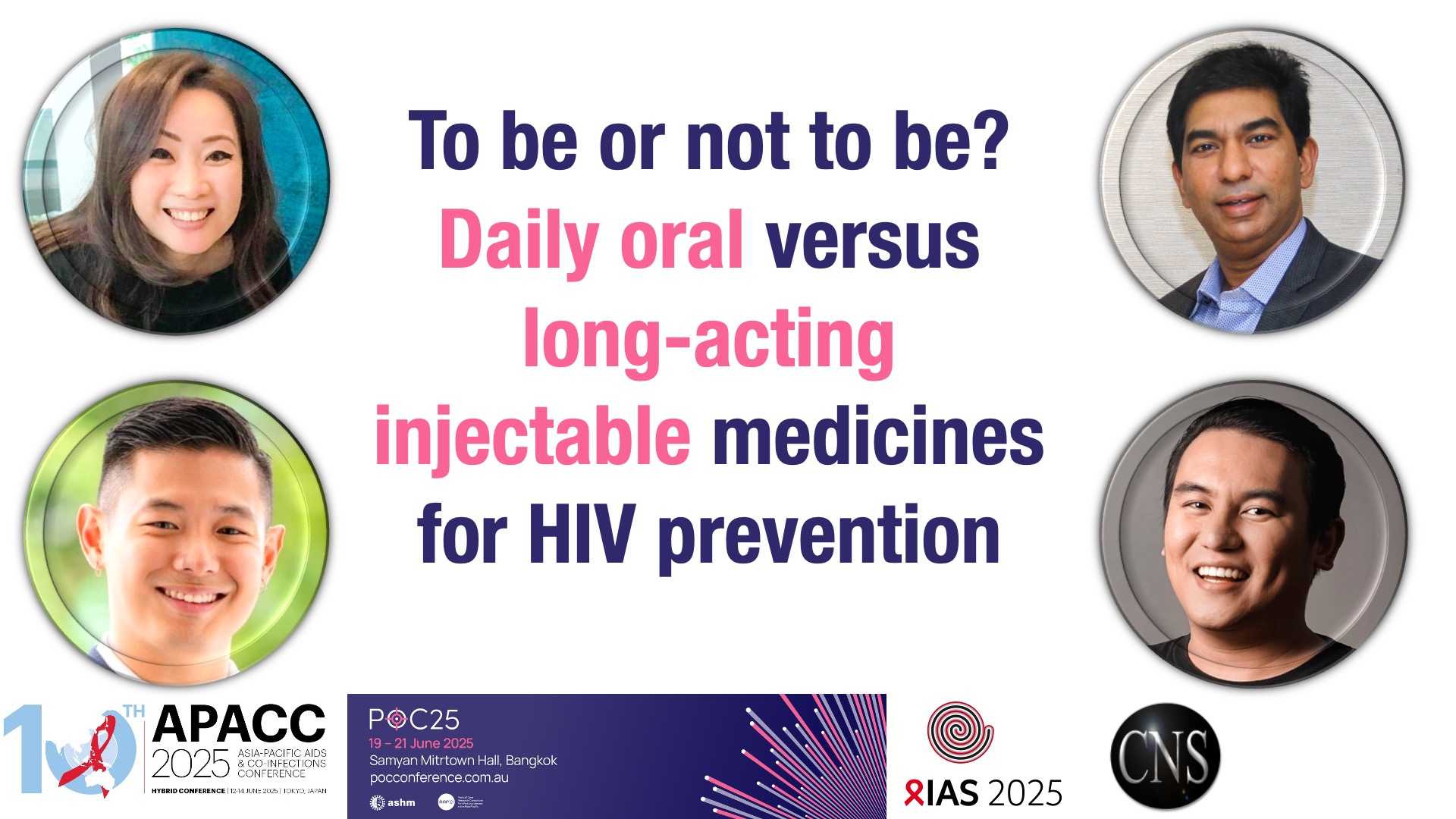
Scientific research has gifted us with a range of evidence-based options to protect ourselves from getting infected with HIV. In 2012, US FDA had first approved Pre-Exposure Prophylaxis (PrEP) daily oral medicines for HIV prevention. More recently, long-acting injectable options of PrEP are also approved. We at CNS listened to the experts on both of these PrEP options so that we can make an informed choice.
Include males too in addressing human papilloma virus and related cancers
Human Papilloma Virus (HPV) is a common sexually transmitted infection. Since an effective HPV vaccine exists and HPV screening and treatment of pre-cancer lesions can save lives, no one should be suffering from any of the HPV related cancer or had to die of it.
Subscribe to:
Posts (Atom)


