Civil society participation vital for public health programming

Rahul Dwivedi, CNS Special Correspondent
KS Roy Hospital (CNS photo)
“We have always known that alongside scaling up diagnostic and treatment services, engaging communities is vital for the success of disease control efforts. This is especially the case for tuberculosis (TB) – an ancient disease surrounded by stigma, discrimination, and misconceptions. The Knowledge-Attitude-Practice (KAP) survey results underline the payoffs of civil society participation in public health programming” said Dr Sarabjit Chadha, Project Director of ‘Axshya’ at the International Union Against Tuberculosis and Lung Disease (The Union). The KAP midline survey results were released on 27th March 2014 in New Delhi.

Accurate and affordable TB diagnosis in private sector becoming a reality

Dr Madhukar Pai
Bobby Ramakant, CNS Special Correspondent
Tuberculosis (TB) care and control does not end with an accurate and confirmed diagnosis, but that is a good start point. It needs to be followed with initiating standard and effective anti-TB treatment (without delay), supporting the person with TB to adhere to the treatment regimen and get cured. Dr Madhukar Pai, Associate Director of McGill International TB Centre, addressed private TB healthcare providers including physicians and laboratory experts in New Delhi before the World TB Day 2014.

Call for public-private health sector to follow standards of TB care

Dr Madhukar Pai
Rahul Kumar Dwivedi, CNS Special Correspondent
Data suggests up to 40-50 per cent of tuberculosis (TB) patients are likely to be accessing healthcare services in private sector. A study done in Lucknow by Dr Rajendra Prasad, former Professor and Head of Pulmonary Medicine, King George’s Medical University (KGMU) showed 44 different prescriptions from physicians for the same TB patient – this is when TB treatment should have been the same in private and public sector both because International Standards for TB care (ISTC) guidelines have been there since 2005 onwards.

Smoking Tobacco Doubles Risk of Recurrent Tuberculosis: New study

[Hindi] Research published on 24 March 2014 provides critical new insight on the harmful links between smoking tobacco and developing tuberculosis (TB). Regular tobacco smoking doubles the risk that people who have been successfully treated for TB will develop TB again—a condition known as "recurrent" TB. The study is the most robust-ever conducted into how smoking tobacco increases the risk of recurrent TB. This study has been published in the April 2014 issue of the International Journal of Tuberculosis and Lung Disease which went online today.

International Respiratory Societies to assist in finding the 3 million “missed” TB cases

[Hindi] A major focus of this World TB Day is the 3 million TB cases that the World Health Organization (WHO) estimates are “missed” each year - that is, cases that go undetected, undiagnosed and untreated. Clearly, this must change if global TB control is to be achieved. “The Forum of International Respiratory Societies (FIRS) is committed to mobilizing all its members to help reach the ‘missing’ 3 million tuberculosis cases”, said Dr Maria Montes de Oca, chair of FIRS. “FIRS members represent 70,000 health professionals working in almost every country of the world, so the capacity to increase case finding and provide TB care that meets the International Standards of TB Care is there.”

Tuberculosis control needs a complete and patient-centric solution

Dr Madhukar Pai, Prashant Yadav and Ravi Anupindi
Whether it is mobile phone service or vacation travel, good businesses know that success depends on providing a complete and customer-centric solution. Should patients with tuberculosis not be offered a complete solution that is patient-centred? After all, millions are affected and a large market at the base-of-the-pyramid (BoP) remains unserved.

How important is nutritional support to TB patients and their families?

Hara Mihalea, CNS Correspondent, Thailand
There is a debate whether providing food packages to TB patients motivates them to stay and successfully complete their treatment and so far there is no evidence to fully support this theory. However, people like me who for years have worked at the patient level, can say with confidence that when families do not know when their next meal will come from, they will not seek care when they are sick because they neither want to lose their daily income nor spend the little money they have at the health centre or hospital. 

Asia Pacific Region Lags Behind in SRHR

Rose Koenders, APA
Shobha Shukla, CNS Columnist
At the last sixth Asia Pacific Population Conference (APPC), held in September 2013 in Bangkok, member States and civil society discussed the status and progress on population and development and to highlight the most urgent needs of the region. The meeting was part of the regional review of the International Conference on Population and Development (ICPD) Programme of Action (PoA). The article below is based upon an interview Citizen News Service (CNS) did with Rose Koenders, Executive Director at Asia Pacific Alliance for Sexual and Reproductive Health and Rights (APA).

Indian approach to limb salvage for people with diabetes

Dr Ajith Kumar Varma
Shobha Shukla, CNS Columnist
The Global Diabetic Foot Conference (DFcon 2014) concluded earlier this week in Los Angeles US. Citizen News Service (CNS) had an opportunity to interact with one of the key faculties and experts on Indian approach to saving the limb for people who are living with diabetes. Dr Ajith Kumar Varma is a Professor and Diabetic Lower Limb and Foot and Ankle Reconstructive Surgeon, in the Department of Endocrinology, Diabetic Lower Limb and Podiatric Surgery, at Amrita Institute of Medical Sciences and Research Centre, Kochi.

Journalists awarded for best reporting on TB

In the run-up to World TB Day on 24 March, the REACH Lilly MDR-TB Partnership Media Awards 2014 were presented in New Delhi, to recognize outstanding and responsible reporting on tuberculosis (TB). The awards were presented by Dr RS Gupta, Deputy Director General (TB), Ministry of Health and Family Welfare, Government of India.

Thrust to 'reach the 3 million' missing TB cases

World TB Day, 24th March
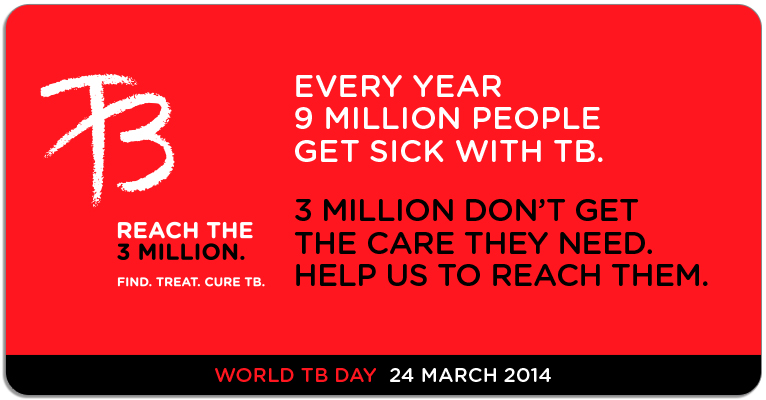
The theme for World TB Day 2014 is 'Reach the 3 million.' Of the nine million people who get sick with TB every year, one third or three million of them are ‘missed’ by health systems. Reaching them and then treating and curing them is an essential step towards achieving Zero TB Deaths and also to halve TB deaths by 2015.

New TB drug development: Guest lecture by Dr. Mel Spigelman

(First published by Irish Forum for Global Health - IFGH)
On Thursday 6th March, the Royal College of Physicians of Ireland saw a gathering of clinicians, nurses, scientists, public health experts and more, to attend an event focusing on development of new medications to treat drug-resistant TB.

Regulating sale of anti-tuberculosis drugs hailed

Rahul Dwivedi, CNS Correspondent 
The government of India’s notification which came into effect on 1st March 2014 aims to arrest irrational sale and use of anti-tuberculosis drugs (and other 45 third and fourth generation antibiotics). “The Union Health Ministry has notified amendments to the Drugs and Cosmetic Act, 1940, in which a Schedule H1 has been included. 1st March 2014 onwards these 46 antibiotics that include anti-TB medicines too will only be sold upon presenting a valid prescription from a medical professional. Government needs to be congratulated for this long overdue measure which will curb irrational sale and use of drugs” said Professor (Dr) Surya Kant, Chairman of UP State Task Force for TB Care and Control and Vice President of Indian Chest Society.

Voices from the ground: Stories of people affected by tuberculosis

Hara Mihalea, CNS Correspondent, Thailand 
42 years old Khun Mouk (name changed) comes from a small village of Chiang Rai in North Thailand and does odd construction jobs for a living. When I met him he looked very ill. His wife said that he had been like this for some time now--not eating and losing weight, coughing, feeling very hot, and feeling very tired. Initially he took several herbal medicines to get better. But when they did not relieve his symptoms he went to a pharmacy as well as two private clinics for help. He was given different kinds of cough syrups, antipyretic medicines for the fever and mucolytic tablets to release his cough.

Gender Violence Increases HIV Vulnerability

Swapna Majumdar, CNS Special Correspondent
Is there a cure for HIV? The success stories of Timothy Brown and the two Boston patients, who rid themselves of the HIV cells through bone marrow transplants, led to hopes that a cure had finally been found. This was further boosted by the fact that the transplants received by them were diametrically different; Brown a transplant with cells that were resistant to HIV and the Boston patients with non-resistant cells. They remained virus-free for months after stopping treatment. However, in December last year, the virus recurred in both the Boston patients.

'2by4 campaign' 2014 launched on World TB Day: 24th March

'2by4', a communications' campaign hosted by Citizen News Service - CNS, a partner of Stop TB Partnership, along with other partners, was first launched in 2013. Over five hundred key informant interviews with people who had either completed treatment for tuberculosis (TB), including drug-resistant TB, or were then on treatment, their family members, other care providers and stakeholders, were done as part of the campaign in 2013. In 2014, the campaign is re-launched before World TB Day, 24th March, as issues it addresses have only gained relevance and urgency over the last year.

Is it the best or the worst of times for women in India?

Shobha Shukla, CNS Columnist
I apologize for missing out on the celebrations of Women's Day this year as I was too engrossed with changing nappies of my 10 month old adorable granddaughter in London, despite her part time nanny - who is a graduate, and charges a frightful £10 an hour. It was only the tedium of dish washer and washing machine which reminded me of women's plight (whether in UK or in India) in a strange sort of way.

No More Holding Back Women

Swapna Majumdar, CNS Special Correspondent
Two thirds of countries globally now have laws against domestic violence with several significant transformations in legal frameworks in Asia and the Pacific. This significant shift over the last decade has not only led 15 countries in East Asia and the Pacific to enact domestic violence laws but six Asian countries have taken the important step of outlawing rape within marriage.

Raising ceiling on election spending is anti-people

Socialist Party (India) leaders said to Citizen News Service (CNS) that recent decision of Election Commission of India to raise the ceiling on election spending in Lok Sabha polls to Rs 70 lakhs is anti-people as it will only make it easier for the rich candidates and political parties to spend money in elections. Similarly raising the deposit amount from Rs 10,000 to Rs 25,000 will make it furthermore difficult for poor people to contest polls.

Rendition of Gandhi Katha at the age of 90

Dr Sandeep Pandey, Magsaysay Awardee and CNS Columnist
Narayan Desai, at the age of 90 years, gave the 115th rendition of his Gandhi Katha in Varanasi at Kashi Vidyapeeth from 21st to 25th February, 2014. When most people at his age would be counting their last days or would be incapacitated, he is moving around and narrating Gandhi’s story in a popular format, usually used by religious people.

Liberal Hinduism versus Sectarian Hindutva

Dr Ram Puniyani, CNS Columnist
Banning or attacking the books in current times has been aplenty. There have been many reasons given for this intolerant attitude by different social-political groups. The cases of Satanic Verses by Salman Rushdie, Taslima Nasreen’s Lajja, book on Sonia Gandhi Red Saree, A.K. Ramanujan’s Three Hundred Ramayans are some of the major examples. There is a tight rope walk between freedom of expression and hurting ‘others’ sensibilities, which keeps fluctuating for same political groups.

75% diabetic-foot related lower limb amputations preventable

Nearly 25% of people with diabetes face diabetic foot related complications in their lifetime. “People with diabetes can develop many different foot problems. Even ordinary problems can get worse and lead to serious complications. Foot problems most often happen when there is nerve damage, also called neuropathy, which results in loss of feeling in your feet. Poor blood flow or changes in the shape of your feet or toes may also cause problems” said Dr Gyan Chand, Associate Professor, Breast and Endocrine Surgery Department, Sanjay Gandhi Post-Graduate Institute of Medical Sciences (SGPGIMS).

IIT-BHU students protest against Coca Cola

Dr Sandeep Pandey, CNS Columnist
On 17th February, 2014, some 300 students of Indian Institute of Technology (IIT) took out a march through the campus against the multinational giants Pepsi and Coca Cola on Banares Hindu University (BHU) campus in Varanasi. There is a plant of Coca Cola in Mehdiganj, Rajatalab on the Varanasi-Allahabad highway about 20 km outside Varanasi where a farmers' movement has been going on against Coke for the last decade. In 2003 and 2004 there were big protests outside the plant on which lathi charges were ordered and hundreds of farmers went to jail. The march by IIT students was in support of the farmers.

Why at present the AAP offers the best hope for governance and policy

Dr Rahul Pandey, CNS Columnist
In a short period of time the Aam Aadmi Party (AAP) has shaken up India’s political landscape by offering an honest alternative to the mainstream national parties, specifically the Congress and the BJP.  This article is an attempt to understand AAP’s credibility on certain crucial dimensions, namely, the integrity of senior leadership; their policy agenda for the underprivileged sections of society; and for the economy and business sector.  While doing so, a brief comparison of AAP with BJP and Congress is also attempted. High personal integrity of senior leaders is a fundamental pre-requisite for good governance.  It is a starting condition for a party to collectively try to envision an India without vested self interests. 

E-Cigarettes: Is it the advent of the end?

Alice Tembe, CNS Correspondent 
Akin to the biblical and religious association to the end-times, unprecedented events occur and humanity perpetuates its own destruction. Having survived atomic bombs, years of epidemic diseases like the Ebola, Human Immune-deficiency Virus and its associate Tuberculosis, the establishment of a chemical mixture to suppress a craving for another equally destructive chemical like nicotine defies the logic to save the human race.

Is E-cigarette Smoking Safe?

Chhatra Karki, CNS Correspondent 
Tobacco companies all over the world are selling Electronic Cigarettes (E-Cigarettes) under the banner of 'safe smoking' in times when 5.4 million people die every year from tobacco related causes. Globally, various campaigns against smoking are on their feet while at the same time the increasing use of E-Cigarettes threatens to thwart all the commendable work done by tobacco control activists.

The gender insensitive leadership of AAP

Dr Sandeep Pandey, CNS Columnist
The comment made by Kumar Vishwas on nurses from Kerala and the Delhi Law Minister’s insistence that Delhi police raid a place which he alleged was being used to run a sex and drug racket have exposed certain weakness of the AAP party. Since it is a party created in a hurry obviously its cadres have not received any kind of training, leave aside ideological training. Unfortunately the top leadership of AAP is bereft of any prominent female member or anybody with feminist outlook.

E-Cigarettes: Friend Or Foe

Carolyn Kavita Tauro, CNS Correspondent
‘Tobacco is one of the leading killers in the world’; ‘smoking is harmful for our health’; ‘smoking can cause lung cancer, heart disease’… We have heard it all before. We also know how once someone gets into the habit of smoking it is very difficult, if not impossible for him/her to quit due to the addictive nature of nicotine. So the tobacco industry, with all its so called concerns for the dying population, has come up with a new alternative to smoking – E-Cigarettes.

'207 against 377' campaign


More than 100 community stakeholders and activists met in New Delhi on 6th February 2014 for a national consultation on Section 377 and for the launch of a new advocacy campaign, '207 against 377' initiated by Pehchan— a 5 year programme (funded by the Global Fund to Fight AIDS, Tuberculosis and Malaria) that works in 17 states of India in close collaboration with India's National AIDS Control Programme to strengthen and build the capacity of community-based organizations to advance and focus on HIV prevention in vulnerable sexual minorities like men who have sex with men, transgenders and hijras.

Breast cancer survivor's crusade to be the change....

Swapna Majumdar - CNS
It was just by chance that Renuka Prasad discovered a pea-sized lump in her breast in 1997. After ignoring it for a couple of days, she consulted a local gynaecologist in Bhatinda, Punjab, where her husband, an army Corp Commander, was posted. She was reassured when the doctor told her that the mammogram showed fatty tissues probably due to hormonal changes in her body – at 49, she was approaching menopause.

Do we really believe in cancer 'prevention is better than cure'?

World Cancer Day: 4th February
Despite alarming cancer rates globally, with worst impact in low- and middle-income countries, one is forced to ponder if we really believe in 'cancer prevention is better than cure'. Cancer treatment is challenging and expensive, with very worrying 5-year survival rates (average 5-year survival varies for different cancers). Still evidence-based list of cancer prevention action-points is lying neglected in most low- and middle-income countries around the world.

Break the silence around cancer

Shobha Shukla - CNS
The focus of this year's World Cancer Day (4 February 2014) is on Target 5 of the World Cancer Declaration: Reduce stigma and dispel myths about cancer, under the tagline 'Debunk the myths' (the 4 myths of-- we do not need to talk about cancer; there are no symptoms of cancer; there is nothing I can do about cancer; I do not have the right to cancer care). Myths indeed these are, and coupled with gender inequities, they restrict women in low resource settings from accessing essential cancer services for early detection and cancer prevention programme.

'Change the Girl's Journey and Change the World'

Swapna Majumdar - CNS
Kate Gilmour UNFPA
If all adolescents in the world were put together they would be the size of India, a country with a population of over 1.2 billion. More than half of the world’s young people entering their reproductive years live in the Asia Pacific. Yet, the young people in this region, many of whom live in poverty, are denied access to sexual and reproductive health information and services. "Their rights are violated, denied and betrayed. It is no wonder that South Asia has the highest levels of child marriage in the world. Six million adolescent pregnancies occur in Asia Pacific, 90 per cent inside marriage. Clearly, very few have autonomy over their bodies," said Kate Gilmour, Assistant Secretary-General and Deputy Executive Director (Programme), United Nations Population Fund (UNFPA).