Not capitalist but economically, socially and ecologically just order can deliver on SDGs

"Anti-rights and anti-gender pushes are driven by political, patriarchal, conservative, and religious bodies that frame wrong understandings of gender as a ‘threat to the social good’. They make it (wrongly) seem that any progressive position on justice- whether it is social, racial, gender, sexual, economic, disability, climate, or ecological- is threatening and destructive to the so-called 'dominant global order.' But we, particularly those of us in the Global South, have to understand it very clearly that this global order is white supremacist, capitalist, and patriarchal, that sustains itself through division, fear-mongering, and the wrong beliefs that ‘a market will fix anything and will fix everything.’ And we know that it does not”, said Dr Angelique V Nixon.

Prevention revolution and policy harmonisation are critical to end AIDS

[हिंदी] Despite having science-based tools for HIV combination prevention, there were 1.3 million people who got newly diagnosed with HIV in 2023 - and also in 2024 - hardly any decline between the two years. Despite having lifesaving antiretroviral therapy to help every person living with HIV healthy and well (and virally suppressed - which also ensures there is zero risk of HIV transmission because treatment works as prevention), 630,000 people died of AIDS-related illnesses in 2023 - and also in 2024 - hardly any decline between the two years. We clearly need a prevention revolution to drastically bring down new HIV infections as well as a lot more needs to be done to reduce AIDS-related deaths. 'Business as usual' is clearly not an option.

SHE & Rights | SDG-3 and SDG-5 under youth lens


Ahead of International Youth Day and International Day of World's Indigenous Peoples, and in lead up to UN General Assembly where SDG-3 and SDG-5 both are under review this year, be welcome to join us in SHE & Rights session on the theme: "SDG-3 and SDG-5 under youth lens."

Protect the lifelines of youth and community-led HIV programmes

Youth-led, rights-based and gender transformative HIV response is key. “Community-led programmes are lifelines of the HIV response, reaching those most in need. As international aid shrinks, these lifelines are the first to disappear. We must protect them,” said UNAIDS. One such lifeline is youth-led programmes for HIV prevention and treatment. We need to protect it.

Person-centred care is the gateway to health for all

The irony of current times is that despite the writing on the wall "health is a fundamental human right," the ground reality cannot be farther from the truth. Over 70% people die of non-communicable diseases (NCDs) - a significant number of them are preventable. An infectious disease like TB, which is preventable and curable, continues to be the deadliest infectious disease worldwide - especially in the Global South. When HIV combination prevention should be a reality, along with treatment as prevention, over 630,000 people died of AIDS-related illnesses in 2024 - and 1.3 million were newly diagnosed with HIV in 2024 (hardly any change when compared with 2023 data). If every life matters, then why is A for accountability, missing from global health?

Remove systemic blockers to enable access for women to economic and labour markets

Unless we remove systemic discrimination, disadvantages and patriarchal barriers, how would we ensure that women and gender diverse peoples in all their diversities are equitably and justly able to access economic markets and labour markets? Economic justice is critical cog-in-the-wheel for development justice.

No health, gender and economic justice without ending wars, invasions and genocides

[हिंदी] While health, gender and other sustainable development goals are reeling under severe funding cuts, governments of richer nations are increasing defence budgets. More shocking is that same governments who are raising spending on militarisation, are the ones committing to ‘peace’ at a global meet on financing for development and refusing on debt cancellation for the Global South nations.

Will we-the-quails unite to lift the net or wither away the gains made in AIDS response?

Let us refresh the old gold Buddhist tale of The Quail and the Net: “Long ago a flock of quails lived in a forest. Everyday a hunter would cast a net and trap many of them. But eventually, a wise quail told the rest that if they worked together, they could lift the net collectively at the same moment and escape as one. Next time the hunter tried to capture them, quails moved in unison, raising the net and flying off together. Unity is strength,” said Eamonn Murphy, Director of UNAIDS for Asia Pacific and Central Asia and Eastern Europe regions around the world’s largest conference on HIV science (13th International AIDS Society Conference on HIV Science).

No health without rights, says Shobha Shukla SDG-3 Lead Discussant at UN meet

[watch the recording] Health and gender equality are indivisible and fundamental human rights. "Right to health cannot be dislocated from gender equality and human rights. We have to ensure that gender equality and human right to health are recognised as fundamental human rights in all countries,” said Shobha Shukla, who was the Lead Discussant for SDG-3 (health and wellbeing) at the United Nations intergovernmental High Level Political Forum (HLPF 2025) at UN HQ in New York (14-23 July 2025). She was speaking on behalf of Asia Pacific Regional Civil Society Engagement Mechanism.

[video] SDG3 Lead Discussant at UN High Level Political Forum (HLPF 2025) Shobha Shukla speaks on human right to health, gender justice and development justice

Reforming global financial architecture is critical for gender equality and right to health

While governments have committed to deliver on Sustainable Development Goals by 2030, inequalities, injustices and deadly divide between the Global North and Global South nations (and within rich and poor nations) has jeopardised progress on SDG goals and targets – including gender equality and right to health – both of which are fundamental human rights.

Richest 1% people have enough new wealth to end annual poverty 22 times over

Recent funding cuts on health, gender equality and human rights have given a sudden blow to a range of important services for the most underserved communities. But solution is not as simple as suggesting low- and middle-income countries to increase ‘domestic investment on health and gender’ or find ‘innovative ways to financing.’

[video] Did 4th Financing for Development deliver on gender equality and feminist agenda?

Cambodia is 2nd Asian country to rollout long-acting injectable HIV prevention option


After Thailand, Cambodia becomes the second Asian country to rollout long-acting and injectable options to protect oneself from getting infected with HIV. United Nations health agency (formally known as World Health Organization or WHO) had first issued its guidelines in 2022, asking countries to deliver long-acting injectable Pre-Exposure Prophylaxis (PrEP), using cabotegravir medicine, as part of comprehensive approach to HIV prevention.

SHE & Rights: Did 4th Financing for Development deliver on gender equality and feminist agenda?


The ninth session of SHE & Rights (Sexual Health with Equity & Rights) will be organised before World Population Day on the theme: "Did 4th Financing for Development meet-outcomes deliver on gender equality and feminist agenda?"

2nd Edition of SHE & Rights Media Awards 2025

(Thanks for applying. No more applications are being accepted now for SHE & Rights Media Awards 2025)

Will governments firewall public health from tobacco industry's lies and deceptive tactics?

A new WHO report launched in June 2025, warrants stronger measures to save lives from deadly tobacco and nicotine products and hold industry liable

[video] First-ever rollout of long-acting injectable cabotegravir Pre-Exposure Prophylaxis (PrEP) in Cambodia

40 years back when first few people in Mumbai and Bangkok were diagnosed with HIV

Although world is not on track to end AIDS by 2030 but it is no less than a miracle when we take into account the scientific and community-led progress which has powered the global AIDS response since 1981 - when for the first time AIDS was reported in the world.

IAS 2025 Affiliated Independent Event: Strengthening competencies and capacities of Global South to end AIDS, end TB, and deliver on all SDG3

Watch the recording

In lead up to 13th International AIDS Society (IAS) Conference on HIV Science (IAS 2025) of which CNS is an official media partner, we welcome you to register for IAS 2025 Affiliated Independent Event on 1st July 2025 (virtual) during 11am to 2pm Rwanda/ South Africa/ Zimbabwe/ Geneva time.

Gender equality and human rights are indivisible, foundational and unconditional

[हिंदी] "When human rights are treated like an 'à la carte menu' by governments, and not what they truly are - indivisible, foundational and unconditional... we move fast into dystopia," said Dr Tlaleng Mofokeng, United Nations (UN) Special Rapporteur on Right To Health.

[video] German Film & TV Actress Annabelle Mandeng's message on 25+ years of NMP+ & social enterprise TAAL+

[video] UNAIDS India Director David Bridger congratulates 25 years of Network of Maharashtra People with HIV

Finding strength in struggle for gender equality and human rights

The year 2025 marks 30 years since the landmark Beijing Declaration and its Platform for Action was adopted in 1995. Despite rising anti-rights and anti-gender pushes, some progress on these bold promises gives hope and strength, to strive for achieving SDG5 fully by 2030 or earlier.

Design health services around people, not the disease

"We need to design services around people, not the disease," rightly said Dr Nittaya Phanuphak. Unless point-of-care health technologies are deployed for those who are most-in-need in a person-centred and rights-based manner, we would fail to deliver on the promises enshrined in #HealthForAll and SDGs goals and targets.

Legalising key population led health services in Thailand is a gamechanger

Legalising key population or community-led health services has been a gamechanger in Thailand to protect most-at-risk people from getting infected with HIV, as well as to take evidence-based standard care to the people living with HIV in a person-centred manner so that they can lead normal healthy lives, said Dr Praphan Phanuphak, a legend who helped shape Thailand's HIV response since the first few AIDS cases got diagnosed in the land of smiles in 1985.

To be or not to be? Daily oral versus long-acting injectable medicines for HIV prevention
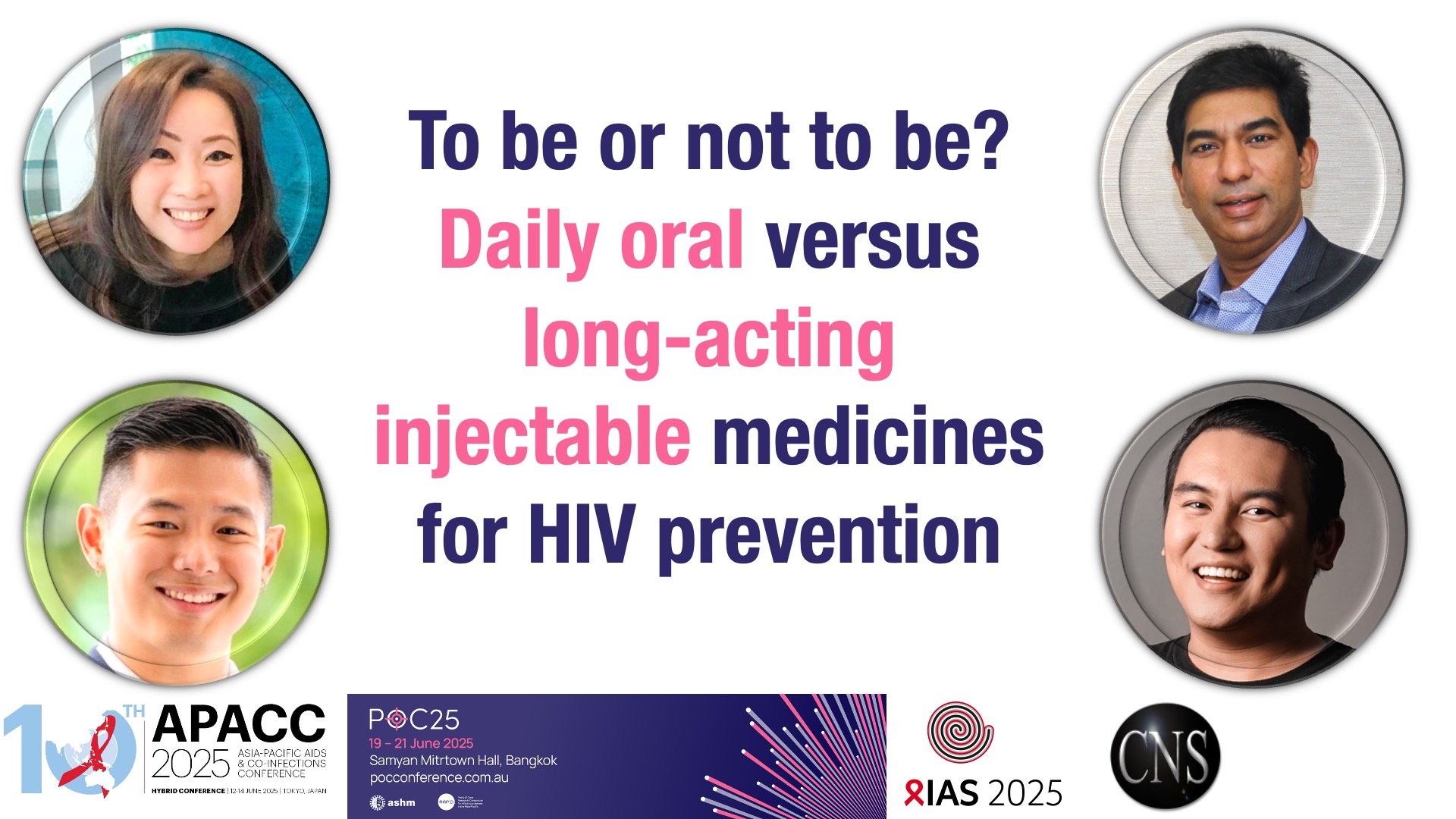
Scientific research has gifted us with a range of evidence-based options to protect ourselves from getting infected with HIV. In 2012, US FDA had first approved Pre-Exposure Prophylaxis (PrEP) daily oral medicines for HIV prevention. More recently, long-acting injectable options of PrEP are also approved. We at CNS listened to the experts on both of these PrEP options so that we can make an informed choice.