
Showing posts with label UHC. Show all posts
Showing posts with label UHC. Show all posts
Put people first mantra to drive WHO task force to save the medicines that protect us


Build the world we want: A healthy future for all

Stopping antimicrobial resistance is the bedrock for advancing universal health coverage
Universal Health Coverage (UHC) Day is 12 December
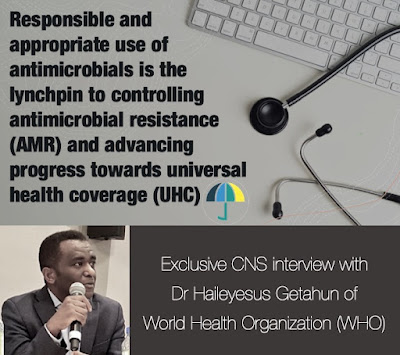
[हिंदी] Stopping antimicrobial resistance by promoting infection prevention, responsible and appropriate use of antimicrobial medicines in human health, livestock and food systems, is the bedrock for promoting universal health coverage. Failing this, the absence of efficacious antimicrobials will effectively return the world to the pre-antibiotic era before the 1920s when lives were lost at a far greater rate due to infection.
Leaders of cities in Asia Pacific commit for united local actions to meet global health goals
#EndTobacco is an essential part of the bedrock for Universal Health Coverage

[हिंदी] Can we deliver on the promise of health for all unless we fix the gaping and widening punctures that are causing epidemic-proportion of preventable diseases and untimely deaths? No one needs to suffer from preventable illnesses or die from curable diseases. Tobacco use kills over 8 million people worldwide every year. While ‘Big Tobacco’ industries become richer, it is the governments and the people worldwide who are not only dealing with mountainous health crises but also becoming more vulnerable to fritter away whatever progress they have been able to make towards the United Nations Sustainable Development Goals and targets.
Community health work is work

Universal access to sexual and reproductive health services is a human rights imperative
 (हिंदी) The Asia Pacific region is home to more than half of the global population and many low income countries. While the region is witnessing rapid economic growth, gender inequalities persist and sexual and reproductive health (SRH) services are far from being available to all. In the lead up to this year's International Women's Day and the forthcoming 10th Asia Pacific Conference on Reproductive and Sexual Health and Rights (APCRSHR10) in Cambodia, CNS Managing Editor Shobha Shukla spoke with Tomoko Fukuda, Regional Director of the International Planned Parenthood Federation for East & South-East Asia and Oceania Region, on advancing gender equality and universal access to sexual and reproductive health and rights (SRHR) in this region.
Niti Aayog must stop plan to privatise public health

Health and treatment literacy is a linchpin for global health security

This Podcast features Dr Dilip Mathai, Vice President of AIDS Society of India (ASI), and Co-Chair of Scientific Committee of ASICON 2019 (12th National Conference of ASI). He was conferred upon the coveted Lifetime Achievement Award by ASI for 2019. Dr Mathai is Dean, and Professor of Medicine & Adult Infectious Disease, at Apollo Institute of Medical Sciences and Research (AIMSR) in Hyderabad.
We cannot end AIDS without combating antimicrobial resistance

Is Universal Health Coverage an opportunity to end AIDS and TB?

Is universal health coverage an opportunity to #endAIDS & #endTB?
 This Podcast features a conversation on "Is Universal Health Coverage (UHC) an opportunity to accelerate progress to end AIDS and TB?"
This dialogue took place on last day of 10th IAS Conference on HIV Science (IAS 2019) in Mexico.
Panelists included:
Is UHC an opportunity to accelerate progress to end AIDS and TB?

Complacency kills: Prevention cannot take a backseat while we scale up treatment coverage to #endAIDS
Shobha Shukla, CNS (Citizen News Service)
 [Webinar recording, podcast] "The global health system is only as strong as its weakest parts" had said UNDP’s Mandeep Dhaliwal in her article around last year's World AIDS Day. The context has only deepened over the year, not only for ending AIDS but also for health security in general. With Universal Health Coverage Day (UHC Day) on 12th December this year, time is running out to catch up on lost opportunities to advance towards UHC.

Subscribe to:
Posts (Atom)