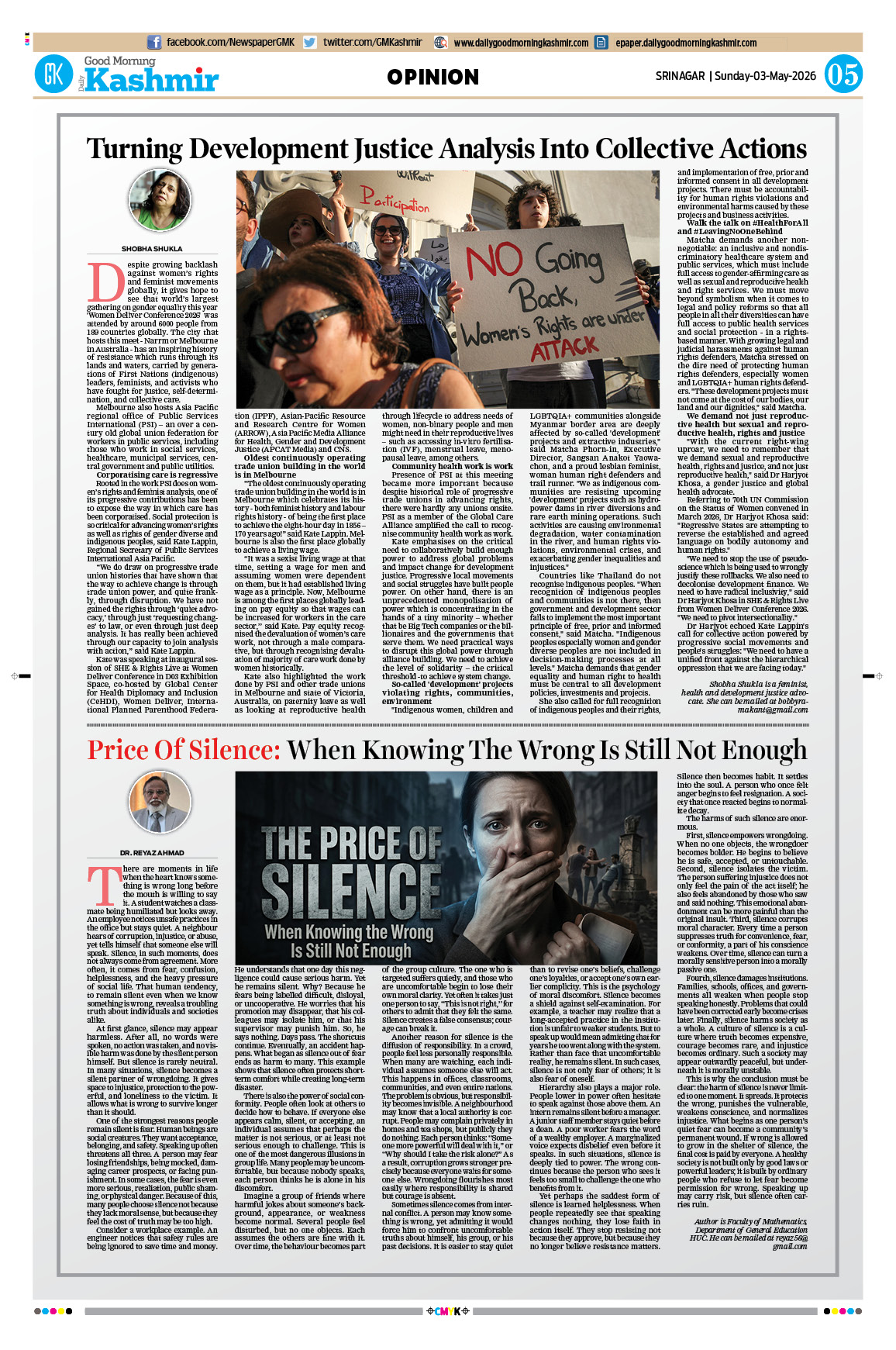
Melbourne also hosts Asia Pacific regional office of Public Services International (PSI) – an over a century old global union federation for workers in public services, including those who work in social services, healthcare, municipal services, central government and public utilities.
Corporatising care is regressive
Rooted in the work PSI does on women’s rights and feminist analysis, one of its progressive contributions has been to expose the way in which care has been corporatised. Social protection is so critical for advancing women’s rights as well as rights of gender diverse and indigenous peoples, said Kate Lappin, Regional Secretary of Public Services International Asia Pacific.
“We do draw on progressive trade union histories that have shown that the way to achieve change is through trade union power, and quite frankly, through disruption. We have not gained the rights through ‘quiet advocacy,’ through just ‘requesting changes’ to law, or even through just deep analysis. It has really been achieved through our capacity to join analysis with action,” said Kate.
Kate was speaking at the inaugural session of SHE & Rights Live at Women Deliver Conference in D03 Exhibition Space, co-hosted by Global Center for Health Diplomacy and Inclusion (CeHDI), Women Deliver, International Planned Parenthood Federation (IPPF), Asian-Pacific Resource and Research Centre for Women (ARROW), Asia Pacific Media Alliance for Health, Gender and Development Justice (APCAT Media) and CNS.
Oldest continuously operating trade union building in the world is in Melbourne
“The oldest continuously operating trade union building in the world is in Melbourne which celebrates its history - both feminist history and labour rights history - of being the first place to achieve the eight-hour day in 1856 – 170 years ago!” said Kate Lappin. Melbourne is also the first place globally to achieve a living wage.
“It was a sexist living wage at that time, setting a wage for men and assuming women were dependent on them, but it had established living wage as a principle. Now, Melbourne is among the first places globally leading on pay equity so that wages can be increased for workers in the care sector,” said Kate. Pay equity recognised the devaluation of women’s care work, not through a male comparative, but through recognising devaluation of majority of care work done by women historically.
Kate also highlighted the work done by PSI and other trade unions in Melbourne and the state of Victoria, Australia, on paternity leave, as well as looking at reproductive health through lifecycle, to address needs of women, non-binary people and men might need in their reproductive lives – such as accessing in-vitro fertilisation (IVF), menstrual leave, menopausal leave, among others.
Community health work is work
Presence of PSI at this meeting became more important because despite historical role of progressive trade unions in advancing rights, there were hardly any unions onsite.
PSI as a member of the Global Care Alliance amplified the call to recognise community health work as work.
Kate emphasises on the critical need to collaboratively build enough power to address global problems and impact change for development justice. Progressive local movements and social struggles have built people power. On the other hand, there is an unprecedented monopolisation of power which is concentrating in the hands of a tiny minority – whether that be Big Tech companies or the billionaires and the governments that serve them. We need practical ways to disrupt this global power through alliance building. We need to achieve the level of solidarity - the critical threshold - to achieve system change.
So-called 'development' projects violating rights, communities, environment
"Indigenous women, children and LGBTQIA+ communities along the Myanmar border area are deeply affected by so-called 'development' projects and extractive industries," said Matcha Phorn-in, Executive Director, Sangsan Anakot Yawachon, and a proud lesbian feminist, woman human right defender and trail runner. "We, as indigenous communities, are resisting upcoming development' projects such as hydro-power dams in river diversions and rare earth mining operations. Such activities are causing environmental degradation, river water contamination, human rights violations, environmental crises, and exacerbating gender inequalities and injustices."
Countries like Thailand do not recognise indigenous peoples. "When recognition of indigenous peoples and communities is not there, then the government and development sector fails to implement the most important principle of free, prior and informed consent," said Matcha. "Indigenous peoples, especially women and gender diverse peoples, are not included in decision-making processes at all levels."
Matcha demands that gender equality and human right to health must be central to all development policies, investments and projects.
She also calls for full recognition of indigenous peoples and their rights, as well as implementation of free, prior and informed consent in all development projects. There must be accountability for human rights violations and environmental harms caused by these projects and business activities.
Walk the talk on #HealthForAll and #LeavingNoOneBehind
Matcha demands another non-negotiable: an inclusive and nondiscriminatory healthcare system and public services, which must include full access to gender-affirming care as well as sexual and reproductive health and rights services. We must move beyond symbolism when it comes to legal and policy reforms so that all people in all their diversities can have full access to public health services and social protection in a rights-based manner.
With growing legal and judicial harassments against human rights defenders, Matcha stresses on the dire need of protecting human rights defenders, especially women and LGBTQIA+ human rights defenders.
"These development projects must not come at the cost of our bodies, our land and our dignities," said Matcha.
We demand not just reproductive health but sexual and reproductive health, rights and justice
"With the current right-wing uproar, we need to remember that we demand sexual and reproductive health, rights and justice, and not just reproductive health," said Dr Harjyot Khosa, a gender justice and global health advocate.
Referring to the 70th UN Commission on the Status of Women convened in March 2026, Dr Harjyot Khosa said: "Regressive States are attempting to reverse the established and agreed language on bodily autonomy and human rights."
"We need to stop the use of pseudo-science which is being used to wrongly justify these rollbacks. We also need to decolonise development finance. We need to have radical inclusivity," said Harjyot in SHE & Rights Live from Women Deliver Conference 2026. "We need to pivot intersectionality."
Dr Harjyot Khosa echoed Kate Lappin's call for collective action powered by progressive social movements and people's struggles: "We need to have a unified front against the hierarchical oppression that we are facing today."
(Shobha Shukla is a feminist, health and development justice advocate, and an award-winning founding Managing Editor and Executive Director of CNS (Citizen News Service). She serves as Chairperson of Global AMR Media Alliance (GAMA), Host and Coordinator of SHE & Rights (Sexual Health with Equity & Rights), President of Asia Pacific Media Alliance for Health, Gender and Development Justice (APCAT Media), and founder leader of DJOP (Development Justice for Older Persons) initiative. She was also the Lead Discussant for SDG-3 at United Nations inter-governmental High Level Political Forum 2025. GAMA , led by her, received the AMR One Health Emerging Leaders and Outstanding Talents Award at UN High Level Ministerial Conference on AMR 2024. Follow her on X @shobha1shukla or read her writings here www.bit.ly/ShobhaShukla)
 is a feminist, health and development justice advocate, and an award-winning founding Managing Editor and Executive Director of CNS (Citizen News Service). She serves as Chairperson of Global AMR Media Alliance (GAMA), Host and Coordinator of SHE & Rights (Sexual Health with Equity & Rights), President of Asia Pacific Media Alliance for Health, Gender and Development Justice (APCAT Media), and founder leader of DJOP (Development Justice for Older Persons) initiative. She was also the Lead Discussant for SDG-3 at United Nations inter-governmental High Level Political Forum 2025. GAMA , led by her, received the AMR One Health Emerging Leaders and Outstanding Talents Award at UN High Level Ministerial Conference on AMR 2024. Follow her on X @shobha1shukla or read her writings here www.bit.ly/ShobhaShukla)
published in:
- CNS
- Daily Good Morning Kashmir, India (op-ed page, 3 May 2026)
- M S N, USA
- Z News Network, Boston, USA
- The Highland Post, Meghalaya, India
- The Health Thread, Canada/ Nepal
- The Indigenous Herald, Tripura, India
- The Northern Daily (TND News), Uganda
- e-Pao News Network, Manipur, India
- Modern Ghana
- Pakistan Christian Post
- Apna Chhattisgarh, India
- Manipur News. India
- Savi News Africa, Nigeria
- Health and Family News, India
- Scoop Independent News, New Zealand
- Op-Ed News, USA
- FYN Media, Cambodia
- World News (WN)
- Left News, USA